Recording ‘real’ instruments

I was reading Slipperman’s guide to recording distorted guitars from hell.

Besides being irreverent, grumpy, shouty, sweary and quite frankly hilarious, it is also highly informative and you learn a lot about the painstaking hours that goes into the craft of recording distorted guitars. It’s an EQ mind field with so many possibilities for things to go horrendously wrong.

He took a real stab at people who record using digital amps, to which I wanted to stand up and applause!

Because if you get a killer sound with killer gear though, you are onto something.

And people do not appreciate the effort of this enough these days!

Don’t get me wrong, I think the emancipation of recorded music is a good thing and everyone can put themselves out there but whilst the whole notion that you can make some things sparkle in quality with a small interface and a laptop is somewhat applicable, it ain’t got nothing on the real deal!

Listen to the opening two tracks of ‘Dirt’ by Alice in Chains, (and then the whole album for that matter). A painstaking amount of hours of thought and effort went into that record and Jerry Cantrell’s guitars sound is UNBELIEVABLY gnarly…heads and shoulders above so many guitar sounds from records today.

I don’t like the fact that so many records that are released today are artificial. I wish there were more records with real guitar and amp set ups, real drums and more mic’ed up stuff in general.

I think it is a gateway that makes it more likelier to make something unique and innovative. I’m not saying this can’t be achieved without it, but nevertheless I crave for more of this aesthetic.

And it’s why I’m proud that I’ve gone out of my way to record in a studio with all of this going on. This last weekend, we spent hours setting up…HOURS before actually pressing the record button. Moving mics, choosing cabs, pedals, guitars, moving knobs and making some informed decisions about what it actually is we are after sound wise.

Either way, what you get in is what you get out, and I applaud effort put into a record and dismiss laziness when I hear it.

From the player, to the gear, to the environment to the actual music itself, there are so many facets which make this whole process endlessly fascinating to me!

It’s worth considering all the options, possibilities and where your voice is in all of it.

Back in the studio

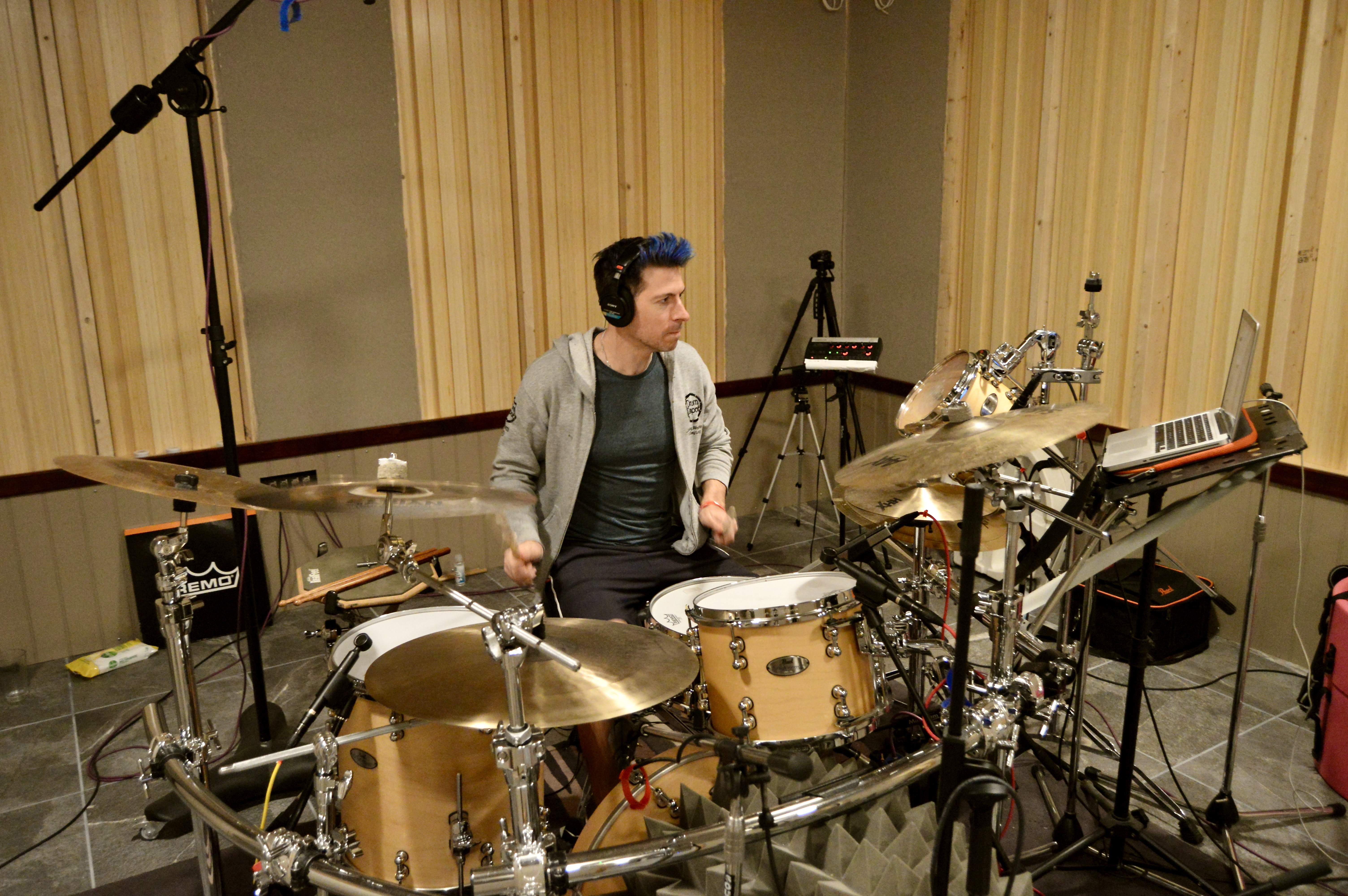
Over the last few days, myself, Aled Lloyd and Andrew Bishop travelled to mid Wales and recorded drums and guitars for my second album.

The studio we are in is Giant Wafer, and it’s an absolutely beautiful environment to create music in.

The direction I have taken with this new record is very different to anything I have done before and I look forward to sharing more details with you.

In the meantime, here are some photos of us in action.

Recording a live performance.

We are in an age where recording devices are aplenty. As is the ability to manipulate the recording to make something appear to be a full take when it’s not.

I take pride when I can do a full performance of something, but sometimes things need editing.

Some people have the privilege and means to record in an environment with endless time to make their craft.

A lot more of us if we do have that space have a precious amount of time in there.

Adrenaline kicks in and we are aware of every error. A 4 minute performance is marred in our head because of an error that took place in a second.

Though, for all this pressure, it’s easy to underestimate a quality that is important.

We are humans, making mistakes and errors is part of the process of making something. When so much has gone well in a take, is it really worth discrediting because of one minuscule discrepancy that only you (or the real analytical snobs) can discern?

There’s also a charm in the imperfection of a note as well.

There’s a subjectivity here, a need for careful judgement, but I know for a fact that aiming for perfection alone sets up a trap for ourselves.

The War of Art

This book changed the way I think.

Steven Pressfield is the author of ‘The War of Art’ and the ingenious thing he did was give a name to something profound and huge that we all deal with.

Resistance.

Resistance is basically the part of your brain that wants you to be comfortable, not take risks, sit down, shut up and do your (day) job. Resistance doesn’t want you to elevate to higher levels because it’s too afraid of the anguish involved in activity that requires a high level of commitment and effort.

This last week, resistance has been grating away at me. It’s made me want to avoid creating, working and made me second guess myself. It isn’t going to go away.

I listen, I allow these thoughts to process, I say thank you but I’ll keep going and press forward, despite it’s incessant nagging. I finally managed to map out a new track and got into a flow state, where I was continuing with my work until 3am.

Once you overcome those voices, you can then engage with doing creative work and it gets easier once you overcome the hurdle of starting.

If you write, if you create, if you want to do something that elevates you, but you won’t because your being held back by something.

Read this book.

Re-recordings

Some things can only be done once.

You can try to replicate it, all the ingredients are the same, but the same emotional investment you gave in that moment isn’t quite ticking this time round.

That always comes to mind every time I hear re-recorded releases. I have a few but none of them supersede the original.

Taylor Swift has just released her versions of ‘Fearless’ and I cross checked the two versions out of curiosity.

Everything’s been done with pinpoint accuracy where things should sound the same, but to my ears, they simply don’t!

Swift really caught the zeitgeist for teenage girls with her second album. I was busy listening to prog metal but I remember friends of mine who had her music on repeat.

There’s an authenticity and innocence in her earlier work, and 12 years down the line, I’d argue it’s nigh on impossible to recreate that magic of the original master.

Just imagine the possibility of a re-recording of any favourite records of yours. I can’t think of any scenario where that would be beneficial.

I understand the motivation and the situation with her label has been well documented, and whilst many will believe she’s been done wrong, everything that took place was legal, make of it what you will.

So what’s the intention with these re-recordings? The most obvious thing to me is the dignity of ownership. It could be and does feel like an act of defiance as well. It could be money, but all parties involved have plenty, but then again, being rich can become a hedonic treadmill.

If fans love it, that’s totally cool and to be respected, I’m just weighing in because it interests me and I think there can be a few lessons to consider.

A.) Careful about what you sign up for and what your rights are. Musicians are notorious for falling into this trap. Be enthusiastic about the work, but stand your ground if a contract looks like it’ll take something away from you.

B.) As artists, what’s the best approach with our time, to look forwards or backwards? To continue creating something new or innovative or try to recreate what’s already done?

Exiles

This song as well as ‘Anything is Possible’, ‘Continents Away’ and ‘Kaleidoscope’ all explore the resolution element of ‘Between a Disillusion and Resolution’.

There is a common thread of introspection in identity, belonging, curiosity and travel and ‘Exiles’ especially deals with the idea that to find out more of yourself, you may need to venture further afield.

British people working overseas are normally referred to as ‘Expats’. The dictionary definition of this is ‘to exile oneself’.

Moving to the Middle East for four years definitely did this for me. During my time at home in Wales in 2015, I felt disillusioned and afraid that I may end up stuck in a dead end for longer than I’d ever want to be. Sometimes, a complete uproot is what is needed. And when the time was right, I always had home to come back to. I’m home in Wales again for the time being and the experiences I had have been amazing.

This song is for those who venture further afield, looking to explore, learn and challenge themselves.

Anything is Possible

This song was inspired the Elizabeth Strout novel of the same name.

Strout has this extraordinary way of writing about human beings in small knit communities. It may be fiction, but the feelings, interactions, desires and fears are as real as anything I’ve ever read.

One particularly moment in the book sees a character returning from her work life in the city to her family’s home and village. She ends up being unable to stay due to an overbearing amount of panic and anxiety as if she returned to a childhood trauma.

The whole idea of running away from a place, a memory or a childhood fascinates me, and ‘anything is possible’ was written with the belief of good fortune, good connections and good things being able to happen, no matter what has happened before, so long as you are open to it.

Continents Away

I’m lucky to have friends from all over the world. The not so good thing about that is being away from them for long periods of time.

Continents Away was written about the moments you get to spend with the people you love, but those moments heightened by the fact you know that you are going to be thousands of miles away from each other.

Living in the Middle East had me experience sense of transience in a more frequent way than I had ever experienced before.

Relationships that are long distance most definitely teach us to seize the moment, but there is also that desire in us to make sure we support each other whilst we are away drawn to whatever it is that steers us in different directions.

Kaleidoscope

I remember losing my gaze in a kaleidoscope my Grandmother use to have and the twisting motion bringing about a new wave of symmetrical colours and patterns.

I wrote this song about celebrating curiosity, especially through the form of travel and the whole notion of things being the same, but different.

Working out in the Middle East gave me that opportunity, to see the world but also meet people from everywhere, and I am happy to have friends that are from all the world.

Whilst there are cultural differences, there are many common values we all share no matter where we are from. Especially in a time where Xenophobia has creeped into the narrative, I wanted to write this song to celebrate the idea of cultures and people from anywhere in the world being able to integrate with each other.

The Upside Down

There’s a reference here but it’s not ‘Stranger Things’

The title was inspired by a quote from ‘Mary Poppins’ the musical where she describes the Banks family as an upside down family.

So much of the story of Mary Poppins is about the tension between a Father’s duty to business, working life and his family.

There are plenty of instances where this has been the case in real life where there are complex problems within a family set up that can sometimes end up buried and cause long term resentment.

Lyrically, it is one of the most complicated topics I cover in the album. The idea of disillusionment and how choices can impact any family but how introspection and seeking resolutions with empathy and forgiveness is a way to come to terms with everything.

The story of Mary Poppins has a wonderful arc for Mr. Banks. I wish that arc can be true for life itself as well.